Experimental Explorer

  • Home
  • Travel Tales
  • Itineraries
  • Photo Stories
  • Contact
One of the less explored trekking trails of India, Dzukou valley, located at the border of Nagaland and Manipur, abundant with lush greenery, calm surroundings and a lavish spread of hills all around, is a visual treat for nature lovers. Here's a virtual peak into its sublime beauty.
After an arduous trek to the top drains all your energy, the initial views of the valley are all you need to get going again.

The only rest house at the top, to serve as your place of stay for the night. You can start seeing this a few kilometres before you actually reach it and from here on, the trail is either flat or slightly downhill.
Be sure to stay overnight and spend time exploring the valley, else you might miss some of the stunning views from inside the valley.
Settle down with some hot food, listening to your favourite songs, and watch the magic of earth rotating faster than it normally does.
Cross wooden bridges across pristine, ice-cold water. Close your eyes, and listen to the sound of nature.

Share
Tweet
Pin
Share
No comments
Having always wanted to explore more of the the North-Eastern part of India, the stories that I heard about the uniqueness of Dzukou valley and the tribal culture of Nagaland made me choose it as my next destination.


I flew from Hyderabad to Dimapur, the only airport and railhead in Nagaland. From the airport, I took an auto to Dimapur railway station, from where you will easily find shared Jeeps to Kohima. Now brace yourselves for a 3 hour long, tiring, bumpy ride on bad roads that will test your fitness and agility, after which you will reach Kohima, the capital city. It was almost sundown by the time I reached there, so I stayed there that night and headed towards a nearby village called Kigwema, the next day. If you are looking for luxurious hotels, Kohima is where you should stay put, because beyond it, in the villages, you will mostly find only basic homestays. I would suggest you to not spend too much time in Kohima and instead explore more of the villages because they are a lot more serene and peaceful.

Kigwema can act as your base camp for the trek to both Dzukou valley and Japfu peak. There are a handful of homestays available here. Unless you go during the peak season (winter/hornbill festival), you should be able to easily find rooms. I would highly recommend Akieno's homestay for their unbelievable hospitality. The heritage village, Kisama, which is also the site for Hornbill festival, is a short hike away from here. The heritage complex, showcasing the different tribes of Nagaland, their architecture and customs, is open all around the year, even when the festival is not on. There is also a museum (closed on Sundays) and a park inside the village.


I then headed to Dzukou valley, which was my primary motivation for the trip. There are two routes to Dzukou valley - the shorter but steeper route starts from Zakhama and the longer but easier route starts from Viswema. Both these places are reachable from Kigwema by a short taxi ride. I chose Zakhama since it was a lot closer to where I stayed, than Viswema. Both the routes are fairly simple and there is already a ton of information out there about the routes that, you can do the trek on your own, but if you are going solo, beware that this is a fairly lesser known trek and during off season you might find few people on the way. If you wish to, you may hire a guide from any of the surrounding villages. It took me about 4 hours to reach the rest house at the top. The temperature drops down rapidly as you go high, so go prepared with sufficient warm clothing and rain gear if you go around monsoon. While it is possible to return back the same day if you are fast enough and start early, I strongly recommend staying there overnight to explore the valley and not miss some of the unforgettable sights of the valley. The rest house has a couple of dormitories, a few rooms and a basic kitchen. I spent the remainder of the day and a good part of the next morning exploring the valley after which I trekked downhill, back again to Zakhama via the same route, and then took a taxi back to Kigwema.

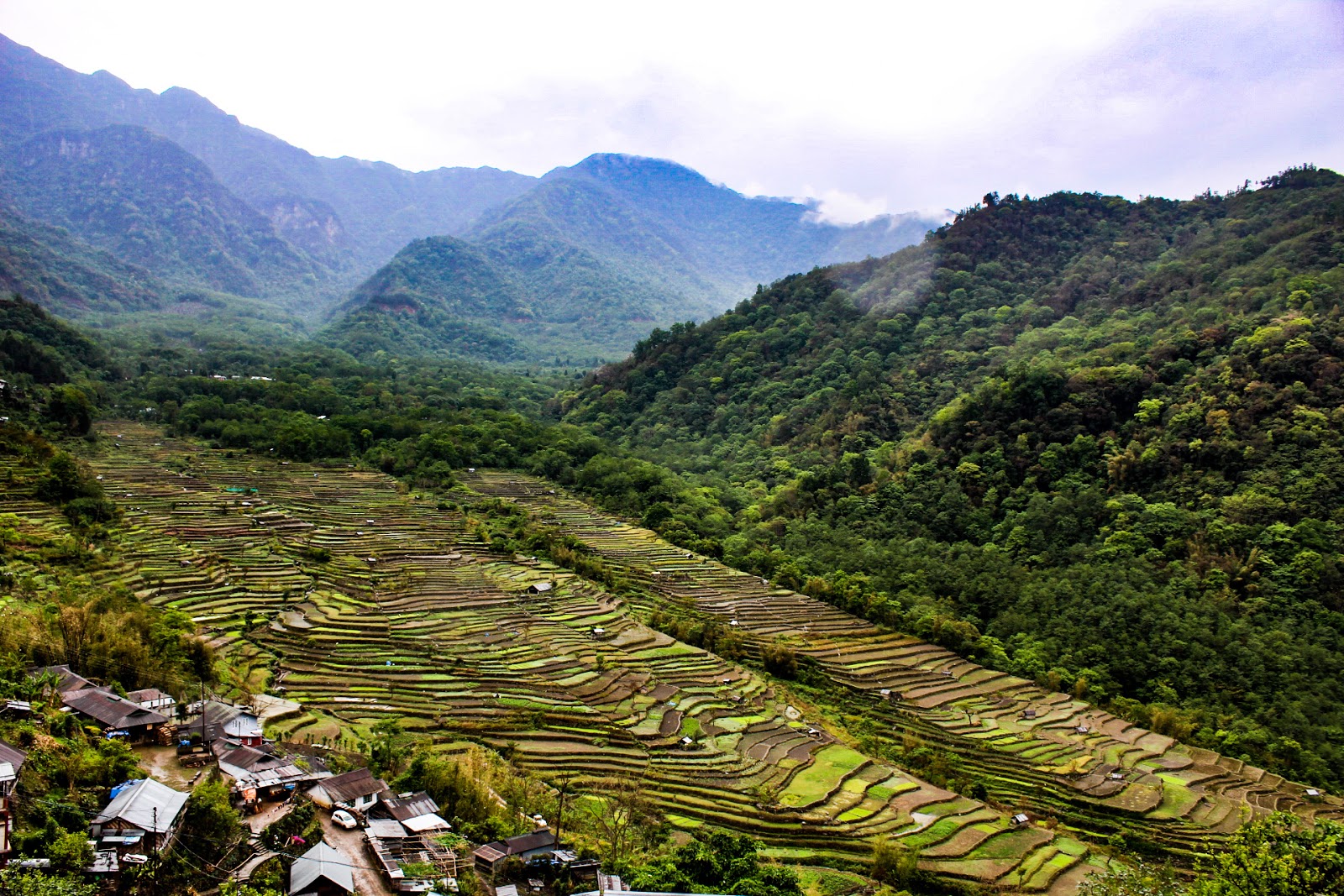
Due to unfavourable weather conditions, I skipped the trek to Japfu peak. My next stop was an Angami village, Khonoma. It is also known as the green village because hunting and cutting down trees are banned here. To reach Khonoma you first need to get to Kohima, and then from there it is an hour's drive by bus or taxi. With its magnificent paddy fields, intriguing architecture and greenery all around, taking a stroll around the village is a pleasant experience by itself, but hiring a guide is recommended if you wish to learn more about it. There is only one bus out of Khonoma, at 5.30 A.M. So, unless you have arranged for your own private vehicle, you need to stay there overnight and take the bus next morning to reach Kohima, which is what I did. While in Kohima, do visit the war memorial.

Paddy fields of Khonoma, the "green village"

My next plan was to visit Mon, in the northern part of Nagaland, where the Konyaks live. A bus from Kohima to Mon would take about 14 hours on bad roads, overnight. So I instead chose to go back to Dimapur, and take a train to Bhojo in Assam (the train would take 4-5 hours). From Bhojo take an auto to Sonari, and then you can take a taxi or a bus and reach Mon in 3 hours. I then went to an intriguing village called Longwa, half of which lies in India, and the other half in Myanmar. This is the only part of Nagaland where you can meet headhunters. Other attractions include the Angh's house, through which the international boundary line runs and the border pillar which gives a vantage point to both sides of the village. You can reach Longwa from Mon by a shared jeep, but the seats are limited and you need to book in advance.

Hills of Mon town in Nagaland at daybreak

To return back to Hyderabad, I did not want to go all the way back to Dimapur to take a flight, so I instead went to  Dibrugarh in Assam which is the closest airport to Mon. You can take a shared jeep from Mon to Sonari. Based on when you reach Sonari, you may or may not find a direct bus to Dibrugarh. I could not get one, so I took a bus to Moran, and then another one to Dibrugarh. It takes 3 hours to reach Sonari, and another 2.5 hours from there to Dibrugarh. The earliest public transport out of Mon is at 7 A.M (It may get further delayed based on how may seats fill up) and there is none on Sundays, so you may want to plan accordingly.

All domestic tourists need an Inner Line Permit to visit Nagaland, which can be obtained in person in Delhi, Kolkata, Guwahati, Shillong (you may need to check the official site for the latest list) or if you are unable to do so, you can get it done via a private tour operator by sending scanned copies of your ID.

Share
Tweet
Pin
Share
1 comments
River ganga flowing through valleys of Himalayas in Uttarakhand

To just say that I’m not a fan of bus journeys, is an understatement. Trapped for long hours in a metal enclosure, sitting crammed in the same place amidst noisy people and the smell of fuel, is probably my least preferred mode of transport. I hate it so much so that, I’d rather travel in an airy, open lorry (Not that I’ve ever had the chance to, but still). However, the past few bus journeys that I took in the Himalayan region have made me change my views about bus journeys.

My first experience of a long bus travel in the Himalayan region was in Uttarakhand last year, when I travelled from Haridwar to Joshimath for more than 10 hours straight. The only means of connectivity to this place is by road and owing to the risk of landslides in this region, buses for this segment operate only during the day time. So, my last hope of managing the long journey by sleeping through it in an overnight-bus was also lost.

Bracing myself for what I thought would be an uneventful, restless journey, I got into a bus early in the morning at 5, from the bus depot at Haridwar. The first hour or so was indeed uneventful and boring but lo and behold, when the Sun began to rise, shedding its glorious light onto the charming Himalayas and the mighty Ganges, they took my breath away. From there on, things only went uphill, both metaphorically and literally. As the bus wound around the hills from the bottom to the top of the state, the Ganges and its tributaries constantly kept me company, caressing the mountains on either side as they did so. The sights were so beautiful that I was befuddled as to whether the mountains and the river were allies, working together to keep me entertained or were they rivals, each fighting the other for my attention? To make things more interesting en route, one can also witness the ‘Panch Prayag’ the confluence of the rivers, each with its own unique color splashing into one, before it officially becomes Ganga.

River ganga flowing through valleys of Himalayas in Uttarakhand

The above ‘more than great’ experience only made me all the more excited when I planned my next visit to the Himalayas, this time in Himachal Pradesh. When I had to take a bus from Shimla to Manali, I deliberately avoided a night bus, and instead booked a day bus, so I could enjoy going around the Himalayas yet again. It started with green, blue mountains, as far as my eyes could see, with the Sun playing its magic again, to make things more pleasant. With a gradual change in the colour of the mountains, it finally ended with white mighty peaks. If it was Ganga the last time, it was Beas this time, which was fighting it out with the mountains, confusing me yet again, as to what I should keep my eyes on.

When I finally reached my destination, I came to realize that for me, one of the best ways to experience the Himalayan region is to travel by road, with the Himalayas in my eyes, wind on my face, a camera in my hands, ARR on my ears, and well, potato chips in my mouth. These, most definitely, more than compensate for the bumpy long rides, crammed in a bus.
View of himalayan mountains from Manali

Share
Tweet
Pin
Share
No comments

Rishikesh is known as either the spiritual capital or the adventure capital of India. For me, with zero interest in spirituality whatsoever, it is just the adventure capital. The thing about monsoons in Rishikesh is, all adventure activities shut down completely. So, when I had to pick a place around Dehradun to rest for a day after a tiring monsoon trek to the Valley of flowers, I was very skeptical about choosing Rishikesh. Nevertheless, I trusted my instincts and went there, and I have no regrets about it.

It was my second time in Rishikesh. I had already fallen in love with this place when I had visited it the first time a few months back, during peak season, when it quenched my thirst for adrenaline with rafting, bungee and more. Monsoon being off-season here, I did not expect much, and thought of mostly chilling indoors to give my legs some much needed rest. Yes, you guessed it right, then the monsoon magic happened, and my plan went for a toss, for good.

The gentle pours of rain lifted the charm of the Himalayas by leaps and bounds, making it more than difficult for me to not get out. I first headed to the Beatles ashram, hoping to enjoy the greenery of the nature trails. It turned out to be an absolute delight (yeah well, except for the mosquito menace). Chirping birds, colourful butterflies, calm surroundings and add to that a bit of quirky graffiti, it was a perfect spot to enjoy the monsoon. Then, there are always cafes overlooking the Ganges to unwind at, which is where I went next. Watching the pitter-patter on the river, while sipping a chocolate milkshake was the second-best way to enjoy the rains (My feet would say it was the best, but don’t listen to them, they were biased). 


Lastly, I went to the Neergarh waterfall that had swollen up due to the rains. Involving a small trek to get close to the waters, this one turned out to be a good call too.


The lush greenery, misty mountains, splashing waterfalls, and the post-rain calmness made me fall in love with Rishikesh all over again. Riding a bike around the hills with no particular destination in mind, I realized, there's more to Rishikesh than adventure, even for the non-spirituals like me.
Share
Tweet
Pin
Share
No comments


Day 1: Hyderabad to Haridwar

I took a morning flight from Hyderabad to Delhi. I then took an afternoon train to Haridwar. It took 5 hours to reach Haridwar. I checked into a hotel close to the railway station and stayed the night.

Day 2: Haridwar to Joshimath

The Haridwar bus stand is very close to the railway station, and from here you easily get buses to Joshimath. However, there are only early morning buses, so you will have to start early. I took a bus at 5 A.M. and reached Joshimath by 3 P.M. I checked into a hotel and stayed overnight at Joshimath.

Day 3: Joshimath to Ghangaria

I checked out and started early in the morning. Since I was planning to return to the same hotel after the trek, I left my luggage there and carried only the things essential for the 3-day trek. I took a jeep to Govind Ghat from the local taxi stand. From Govind Ghat, you need to take another jeep to Pulna, which is the starting point of the trek. From here, it is a 10 km trek uphill, to Ghangaria. I started the trek around 9 A.M. and reached Ghangaria by around 2 P.M. Most part of the route is dotted with frequent stalls from where you can get water and food, and the trek route is pretty clear throughout. After checking into a hotel at Ghangaria, I took a stroll to a nearby waterfall, which was less than a kilometer away. I spent some time there before retiring for the day.

Day 4: Valley of flowers

I got some food packed for lunch and left my room early in the morning. The check-post to the valley opens at 7A.M., so make sure you reach on time to make the most of the day (The entry point is about a kilometer from Ghangaria). It is a unidirectional (except for a small detour to the Legge’s memorial grave) trek with a clear trail that you can do on your own. There are no stalls in this route, so go prepared. Camping inside the valley is not allowed since it has an exit time of 5.30 P.M. An average person should be easily able to make it till the Pushpavati riverbed and back to the gate on time, covering a total of about 12 km.

Day 5: Hemkund Sahib

I got some food packed and started early towards Hemkund Sahib. This trek route is also dotted with frequent stalls throughout. It is a steep 7 km climb one way, to the Gurudwara situated on the banks of a scenic lake. There is no place to stay at the top. After spending some time by the lake, I returned back to my room in Ghangaria and retired for the day.

Day 6: Ghangaria to Joshimath; Auli

I checked out from my hotel at about 6 A.M. and started trekking back to Pulna. This is the same trail that one takes from Pulna to Ghangaria but climbing down was easier and I reached Pulna by 9 A.M. I then took a jeep to Govind Ghat and then another one to my hotel at Joshimath. After checking in and having lunch, I left for Auli. I took the ropeway from Joshimath to Auli. After spending some time at Auli, I returned back to Joshimath by ropeway again.

Day 7: Joshimath to Rishikesh

I checked out early and took a bus to Rishikesh. There are only early morning buses available, so you will need to start early. I took a bus at 5.30 A.M. and reached Rishikesh by 3.30 P.M. I checked into a hotel and rested for the day.

Day 8: Rishikesh

Monsoon is off season at Rishikesh, so none of the adventure activities were open. I rented a two-wheeler from one of the many bike rentals available and spent the day at Beetles ashram, Ganga view cafes, Laman Jhula, and Neergarh waterfalls.

Day 9: Rishikesh to Hyderabad

I checked out from the hotel and took a cab to Dehradun. I then flew back to Hyderabad via Delhi.


Share
Tweet
Pin
Share
No comments


Day 1

I took a morning flight from Hyderabad to Dehradun via Delhi. There is a pre-paid taxi stand at the airport, from where you can take a cab to Rishikesh. It takes about half an hour to reach Tapovan area in Rishikesh. After checking in at the hotel at around 2 PM, I went rafting. There are many offices in Tapovan which cater to this. You can also ask the staff at the hotel to arrange for the same. They pick you up from the hotel, take you till Shivpuri which is the starting point for rafting and also drop you back later. The activity takes about 3-4 hours and includes rafting (16 km), bodysurfing and cliff jumping.

Day 2

I spent most of the day in local sightseeing, covering Laxman jhula, Ram jhula and Goa beach. Rishikesh is best explored on feet, and moreover these places are not too far away from each other and from Tapovan, so I did not need a taxi. While you are at it, there are many cafes near Laxman jhula that provide great food at nominal rates, that you can try. Pick the ones with a river view to unwind and relax.

Day 3

This day was well spent at Jumpin heights, an extreme adventure zone less than an hour away from Rishikesh. Their office is in Tapovan from where you can take a shuttle to reach the jump zone. They have three adventure activities including bungee jumping. It took me about 5 hours (including wait time) to finish all three after which I took the shuttle back again to Rishikesh. This place is highly recommended, and it is better to make prior reservations, especially for the bungee. You can find more details here.

Day 4

I rented a two-wheeler for half a day (You can easily spot bike rentals all around Tapovan) and went around the hills, looking for serene views. I found quite a few of those, where I spent some time relaxing and clicking pictures. I checked out from the hotel after lunch and took a cab to Dehradun. I then flew back to Hyderabad, again via Delhi.


Share
Tweet
Pin
Share
No comments
Older Posts

About me


About Me

Welcome to Experimental Explorer! My name is Kavipriya and I’m a travel and photography hobbyist. I will be sharing my travel experiences, stories, itineraries and photographs here. I mostly do solo, budget travels to quaint and serene places in India.

Follow Me

  • >
  • Instagram
  • <

Categories

  • national parks
  • northeast india
  • solo travels
  • treks

Popular Posts

  • Contact
  • Nagaland
  • A rainy day in Rishikesh

All posts

  • ▼  2019 (1)
    • ▼  March (1)
      • Birding at Paradise
  • ►  2018 (4)
    • ►  September (1)
    • ►  May (1)
    • ►  January (2)
  • ►  2017 (7)
    • ►  December (7)
© COPYRIGHT 2017-2020 KAVIPRIYA ADHINARAYANAN | EXPERIMENTAL EXPLORER
All rights reserved. Unauthorized use of the contents of this page is strictly prohibited and is a punishable offence.

Created with by BeautyTemplates